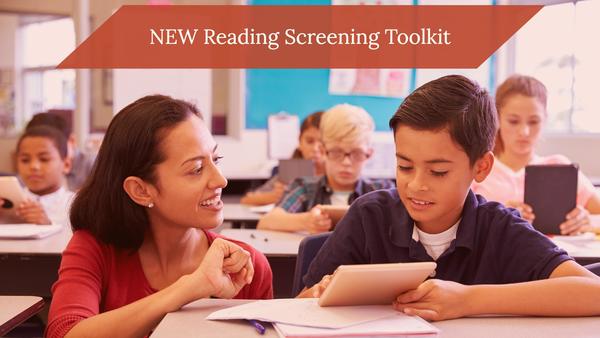
Some students reach the middle grades unable to read grade level text effectively and with understanding. These students need to be identified (typically, students who are two or more grade levels behind in reading) and provided with intensive intervention. This toolkit provides resources for screening all students and identifying those with significant reading difficulties.
Bjork, R. A., Dunlosky, J., & Kornell, N. (2013). Self-regulated learning: Beliefs, techniques, and illusions. Annual Review of Psychology, 64, 417-444.
Dembo, M. H., & Eaton, M. J. (2000). Self-regulation of academic learning in middle-level schools. The Elementary School Journal, 473-490.
Dunlosky, J., & Lipko, A. R. (2007). Metacomprehension: a brief history and how to improve its accuracy. Current Directions in Psychological Science, 16(4), 228-232.
Hacker, D. J., Dunlosky, J., & Graesser, A. C. (Eds.). (2009). Handbook of metacognition in education. Routledge.
Flavell, J. H. (1979). Metacognition and cognitive monitoring: A new area of cognitive developmental inquiry. American Psychologist, 34(10), 906-911.
Lovett, M. C. (2013). Make exams worth more than the grade: Using exam wrappers to promote metacognition. In M. Kaplan, N. Silver, D. Lavaque-Manty, & D. Meizlish (Eds.), Using reflection and metacognition to improve student learning: Across the disciplines, across the academy (18-52). Sterling, VA: Stylus Publishing.
Paris, S. G., & Paris, A. H. (2001). Classroom applications of research on self-regulated learning. Educational Psychologist, 36(2), 89-101.
Pintrich, P. R. (2000). The role of goal orientation in self-regulated learning. In M. Boekaerts, P. Pintrich, & M. Zeidner (Eds.), Handbook of Education (451-502). San Diego, CA: Academic Press.
Pintrich, P. R., & De Groot, E. V. (1990). Motivational and self-regulated learning components of classroom academic performance. Journal of Educational Psychology, 82(1), 33.
Schunk, D. H., & Zimmerman, B. J. (1998). Self-Regulated Learning: From Teaching to Self-Reflective Practice. New York: Guilford Press.
Schunk, D. H., & Zimmerman, B. J. (2003). Self‐regulation and learning. In W. Reynolds & G. Miller (Eds.), Handbook of Psychology (59-76). Hoboken, NJ: John Wiley & Sons.
Schunk, D. H., & Zimmerman, B. J. (Eds.). (2012). Motivation and self-regulated learning: Theory, research, and applications. Routledge.
Tuysuzoglu, B. B., & Greene, J. A. (2015). An investigation of the role of contingent metacognitive behavior in self-regulated learning. Metacognition and Learning, 10(1), 77-98.
Zimmerman, B. J. (2002). Becoming a self-regulated learner: An overview. Theory into Practice, 41(2), 64-70.
Zimmerman, B. J., Bonner, S., & Kovach, R. (1996). Developing Self-Regulated Learners. Washington D.C.: American Psychological Association.
Zimmerman, B. J., & Schunk, D. H. (Eds.). (2012). Self-regulated learning and academic achievement: Theory, research, and practice. Springer Science & Business Media.
Zumbrunn, S., Tadlock, J., & Roberts, E. D. (2011). Encouraging self-regulated learning in the classroom: A review of the literature. Metropolitan Educational Research Consortium (MERC).
Retrieval Practice involves engaging students in activities that require them to actively recall information that they have learned previously. This method has been demonstrated in a variety of classroom and lab studies. While it can take on a variety of formats, (i.e., discussion, writing, quizzing), retrieval practice is most effective when students are quizzed in a low-stakes setting such that they are practicing showing what they know.
MSMI provides professional development, videos, and instructional material to help teachers implement research-based strategies in their classrooms.
Activating students’ background knowledge before reading a text greatly increases their reading comprehension. One way of activating background knowledge is to explicitly teach important vocabulary words before reading by using vocabulary maps, which support students’ vocabulary development and reading comprehension.
Are you looking for ideas to improve your communication with parents? Check out these three tips for creating newsletters to keep parents informed about what’s going on in your classroom. Read more from Edutopia
Middle School Matters Field Guide Alignment
School Climate, Culture, and Partnerships Principle 2: Create a school environment in which mutually supportive relationships among students, teachers, and parents can develop.
More Tools for Improving School Climate, Culture, and Partnerships
Please feel free to share these resources with your colleagues
 Newsflash! MSMI releases a NEW Toolkit:
 Are you looking for ideas to improve your communication with parents? Check out these three tips for creating newsletters to keep parents informed about what’s going on in your classroom.