Research Base for Establishing an Early Warning Indicator System

Alexander, K., Entwisle, D., & Horsey, C. (1997). From first grade forward: Early foundations of high school dropout. Sociology of Education , 70 , 87-107.

Allensworth, E. M., & Easton, J. Q. (2005). The on-track indicator as a predictor of high school graduation. Chicago, IL: Consortium on
Chicago School Research.

Battin-Pearson, S., Newcomb, M. D., Abbott, R. D., Hill, K. G., Catalano, R. F., & Hawkins, J. D. (2000). Predictors of early high school dropout: A test of five theories. Journal of Educational Psychology, 92 (3), 568-82.

Finn, J. D., & Rock, D. A. (1997). Academic success among students at risk for school failure. Journal of Applied Psychology, 82 (2), 221-234.

Garnier, H. E., Stein, J. A., & Jacobs, J. (1997). The process of dropping out of high school: A 19-year perspective. American Educational Research Journal, 34 (2), 395-419.

Jimerson, S. R., Anderson, G. E., & Whipple, A. D. (2002). Winning the battle and losing the war: Examining the relation between grade retention and dropping out of high school. Psychology in the Schools, 39 (4), 441-457.

Neild, R., Balfanz, R., & Herzog, L. (2007). An early warning system. Educational Leadership, 65 (2), 28-33.
 

Research Base for Effective, Timely Feedback for Students

Agarwal, P. K., Bain, P. M., & Chamberlain, R. W. (2012). The value of applied research: Retrieval practice improves classroom learning and recommendations from a teacher, a principal, and a scientist. Educational Psychology Review, 24(3), 437-448.

Black, P., & Wiliam, D. (1998). Inside the Black Box: Raising Standards through Classroom Assessment. Phi Delta Kappan, 1-13.

Butler, A. C., Karpicke, J. D., & Roediger, H. L. (2008). Correcting a metacognitive error: Feedback increases retention of low-confidence correct responses. Journal of Experimental Psychology: Learning, Memory, and Cognition, 34, 918-928.

Dweck, C. S. (1999). Caution: Praise can be dangerous. American Educator, 23(1), 1-5.

Hattie, J. A., & Yates, G. C. (2014). Using feedback to promote learning. In V. A. Benassi, C. E. Overson, & C. M. Hakala (Eds.). Applying science of learning in education: Infusing psychological science into the curriculum. Retrieved from the Society for the Teaching of Psychology web site: http://teachpsych.org/ebooks/asle2014/index.php

Hattie, J. (2012). Know thy impact. Feedback for Learning70(1), 18-23.

Hattie, J., & Timperley, H. (2007). The Power of Feedback. Review of Educational Research, 77(1) 81-112.

Fisher, D. & Frey, N. (2012). Making time for feedback. Educational Leadership, 70 (1), 42-46.

Gan, M. J., & Hattie, J. (2014). Prompting secondary students’ use of criteria, feedback specificity and feedback levels during an investigative task. Instructional Science42(6), 861-878.

Kluger, A. N., & DiNisi, A. (1996). Feedback interventions: Toward the understanding of a two-edged sword. Current Directions in Psychological Science, 7(3), 67-72. 27.

Pashler, H. Cepeda, J. T., Wixted, J. T., & Rohrer, D. (2005). When does feedback facilitate learning of words? Journal of Experimental Psychology, Learning, Memory, & Cognition, 31(1), 3-8. 28.

Shute, V. J. (2008). Focus on formative feedback. Review of Educational Research, 78(1), 153-189. 30.

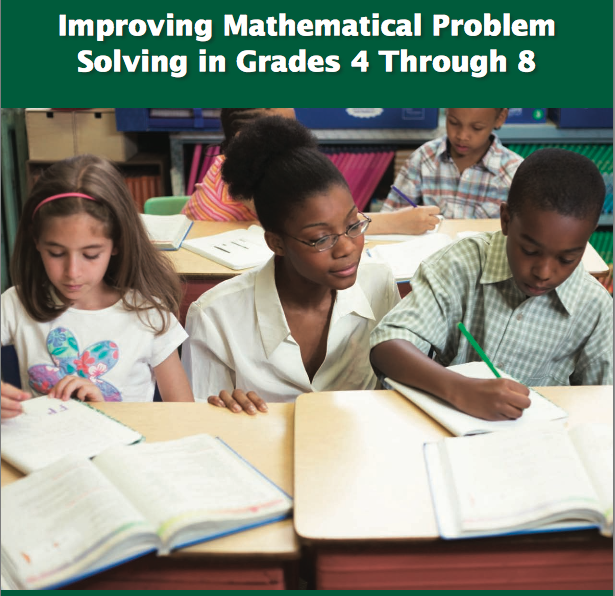
Improving Mathematical Problem Solving in Grades 4 Through 8

improving-math-problem-solvingRecommendation 2

Assist students in monitoring and reflecting on the problem-solving process.

In math, instruction in problem solving is a vital for students to achieve college and career readiness. The What Works Clearinghouse has five recommendations for problem-solving in middle school that align with the MSM Field Guide’s research-based practices to help math teachers provide instruction in this area. This week we’ll be showcasing Recommendation 2: Assist students in monitoring and reflecting on the problem-solving process. (Safari users scroll to page 23 of the document)

Middle School Matters Field Guide Alignment

Mathematics and Mathematics Interventions
Math Principle 4: Develop students’ conceptual understanding of mathematics and provide ample opportunities to improve procedural fluency.
Math Principle 6: Instructions should include strategies for solving word and algebra problems that are based on common underlying structures.


More Tools for Improving Problem Solving

Schema-Based Instruction

The following schema-based instruction videos refer to teaching students the different word problem types so that students can solve word problems more efficiently. Students use the UPS Check strategy as a general word problem attack strategy while using their knowledge of word problem types.

Connecting Visuals to Problem Types

Math coaches and teachers can use this tool as a quick reference regarding appropriate visual representations for different types of problems. The purpose of the tool is to provide references that teachers and coaches can use while planning instruction in using visual representations in problem-solving.

Helping Students Use Textual Evidence

Watch Brenda Torrez, Social Studies & ELA teacher from Heritage Intermediate School, demonstrate a practical and easy to use, hands-on strategy for helping students use textual evidence to support their answers.


This strategy aligns with the Middle School Matters Field Guide Reading Principle 3, Practice 1: Instruct students to use text to support answers.


More Tools for Generating Leveled Questions