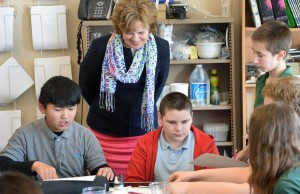
The room at Erie’s Roosevelt Middle School is called the “data room” for good reason. The walls are covered with color-coded cards detailing everything a teacher might need to know about students at risk for dropping out of school: their attendance, their behavior and the courses they’re failing. But that’s about to change. Soon the school will trade in the cards for the Opening Doors Early Warning System, a computer-based “dashboard” that…
This installment of the Middle School Matters Institute Blog focuses on using early warning indicator systems to improve student performance and reduce the risk of future high school dropout.
Contributors:
Doug Elmer, Diplomas Now, Johns Hopkins University (Research Perspective)
Kelsey Lyons Trojacek, School Social Worker, Revere Middle School, Houston Independent School District (Practice Perspective)
The Research Perspective
Over the past decade, educators, researchers, and policymakers have worked together in a concerted effort to increase graduation rates and end the dropout crisis in this country. Although significant progress has been made, far too many students leave the school system before graduating. Nationally, one in five students drops out prior to graduation, with students of color making up a disproportionate number of dropouts across the country. The good news is that through the use of early warning indicator (EWI) systems, educators can accurately identify before high school the students most likely to drop out, empowering teachers and schools to provide supports and interventions to remedy the challenges these students face and to substantially increase the likelihood that they complete high school and move on to postsecondary education.
In recent years, EWI systems have emerged as critical, strategic tools in the effort to ensure that every student remains on track toward a high school diploma and postsecondary opportunities. EWI systems use readily available data to alert teachers and administrators to students who are on the pathway to dropping out. EWI systems grew out of a simple premise—that data could identify students who, absent intervention, were likely to leave the education system. EWI systems guide educators toward the most efficient and effective responses, which include not only student-level interventions, but also classroom, school, and even district actions.
The research behind EWI systems grew out of the larger body of research on dropout prevention and recovery. Researchers noted that a disproportionately small subset of America’s high schools produced the majority of the nation’s dropouts (Balfanz & Legters, 2004) and that performance during the freshman year—particularly with regard to attendance and credit attainment—was closely correlated with high school graduation (Allensworth & Easton, 2005). Researchers at the University of Chicago Consortium (Allensworth & Easton, 2007), Johns Hopkins University, and the Philadelphia Education Fund (Balfanz, Herzog, & Mac Iver, 2007) built on these studies by looking more closely for patterns in longitudinal data and individual student records. Their analysis found that the following three factors—now commonly referred to as the ABC indicators—were the strongest predictors of dropping out:
Attendance—students who missed more than 20 days of school
Behavior problems—students who exhibited serious behavior problems (resulting in suspension) or who exhibited persistent, lower-intensity misbehavior, as evidenced by a conduct grade or referrals
Course failures—students who received a failing grade in language arts or mathematics
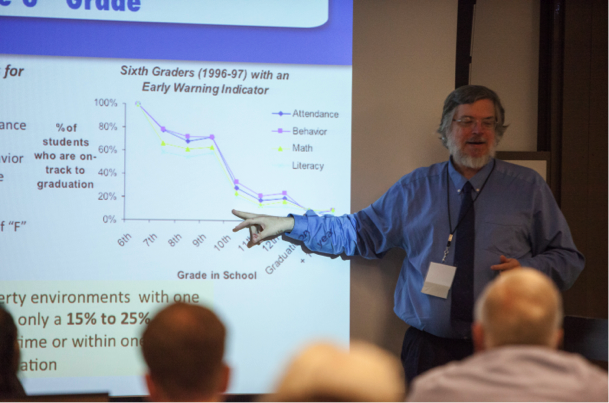
At the 2013 Middle School Matters Institute Summer Conference, Dr. Robert Balfanz of Johns Hopkins University presents on the use of early warning indicators to identify students at risk of dropping out.
Further, the Philadelphia study found that students at risk of dropping out could be identified as early as sixth grade. Since the publication of these initial studies, their findings have been validated many times with state and large district longitudinal studies in Arkansas, Boston, Colorado, Florida, Indianapolis, Metropolitan Nashville Public Schools, and Tennessee (Bruce, Bridgeland, Fox, & Balfanz, 2011). More recent studies have demonstrated that districts can identify students at risk of dropping out at nearly any grade level (West, 2013).
The growing body of research validating EWI systems provides several important criteria that effective EWI systems share (Bruce et al., 2011; Mac Iver & Mac Iver, 2009). Districts and schools seeking to launch an EWI system should use these criteria as guideposts during the development phase:
Build an effective EWI data system: An effective EWI data system provides clear, accurate information around “high-yield” indicators. High-yield indicators—especially attendance, behavior, and course performance—are highly predictive of a majority of dropouts. Although the thresholds for these indicators may vary across districts and states, numerous research studies have confirmed the validity of these primary indicators. EWI data systems should emphasize accuracy over complexity and strive to update data, so that information is as close to real time as possible. All educators, support providers, administrators, and other stakeholders invested in the EWI system should be given appropriate initial and follow-up training and access to the EWI data system.
Develop a tiered intervention system to respond to EWI data: Although EWI data effectively identify students in need of additional intervention, schools must effectively organize their staff and leverage resources to meet the needs of off-track students. Schools need to engage the “second team” of adults in their school building—counselors, social service providers, tutors, and other student support personnel—in developing a resource map and strategic plan to guide the school’s response to EWI data and use the EWI data to allocate resources and prioritize the work of this team. Further, this team must be integrated with the teaching staff and administration, so that every adult responsible for identifying students in need of support and designing and delivering interventions engages in this work in a coherent, coordinated manner.
Provide time during the professional day to discuss EWI data as a team: A common trait among districts and schools that effectively use EWI data to develop student interventions and guide school improvement is the creation of common planning time among educators who share groups of students. A common practice among middle schools is to build in common planning time for grade-level teams to analyze EWI data and determine interventions. Schools that effectively use EWI data during common planning times employ a designated facilitator for these discussions, establish protocols for discussion and decision making, and keep careful records of decisions teams make regarding the design and delivery of student interventions. Teachers, administrators, and student support personnel mentioned above are all included in these EWI team meetings, and every team member plays a distinct role within the EWI analysis, intervention delivery, and progress-monitoring process.
Below, Kelsey Lyons Trojacek of Revere Middle School in Houston Independent School District, a Middle School Matters “Tier II” school, shares the school’s experience in establishing an EWI system and the resulting challenges, successes, and lessons learned.
Reflections From the Field
At Revere Middle School, we strive for our students to be Ivy Leaguers, sports stars, scientists, business leaders, inventors, engineers—you name it! However, we noticed too many students becoming ineligible for sports and activities, not enough National Junior Honor Society members, too many average students at risk of not moving on to high school, and unbalanced grade distribution reports. Our campus has amazing teachers and a dedicated staff, so apathy and incompetence were not concerns. But data indicated that our current practices were not preparing students for success. As a result, we began implementing an EWI system to identify and intervene with students on the verge of heading toward failure. Houston Independent School District is a school-of-choice district and has a widespread magnet program. Students may apply to any magnet school, regardless of home address, and transportation is provided with acceptance into the school. These magnet schools have a number of foci: science, technology, engineering, and mathematics (STEM); energy; law enforcement; aviation; performing arts; business—the list goes on. We want these magnet high schools to want Revere Patriots in their student body, but we have to do our part in getting our kids ready!
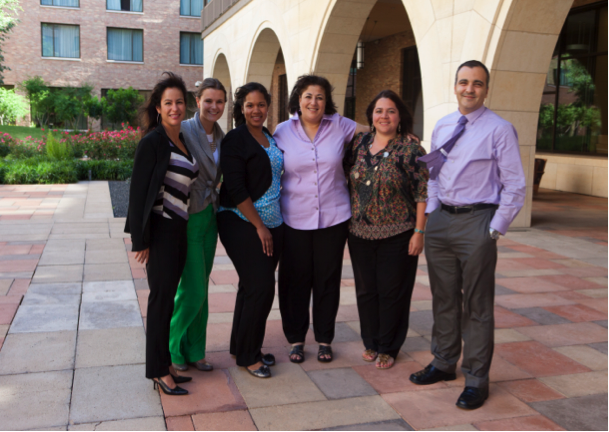
The Revere Middle School leadership team attended the 2013 Middle School Matters Institute Summer Conference and learned about early warning indicator systems along with other research-based practices that improve outcomes for middle grade students.
Early Warning Indicator System Goals: Changing Our Student Portrait
Our ultimate goal at Revere Middle School is to make school a better place for everyone. In setting up an EWI system and targeting specific student needs, we hoped to reduce discipline referrals, so teachers and administrators could focus their time and energy on instruction, not consequences. Specifically, we set out to do the following:
Reduce the number of students failing multiple classes (core and elective)
Reduce the risk of dropout due to behavior, absences, grades, age, and status
Reduce the number of discipline referrals
Increase teacher awareness of student needs (personal and educational) and grading practices
Overcoming Obstacles
All systems-level changes must overcome challenges. Our biggest obstacle was the large number of students initially flagged as being at risk. The initial EWI report in our system resulted in more than 75 pages of students!
We had to refine our indicators to generate a more manageable number of target students. This first cohort included (a) every student who was at least 2 years overage and (b) every student who was absent more than 8% of the total school days. We excluded (a) every student who was failing three or fewer classes and (b) every student failing only elective classes. The list of students was still large, so we examined the data for patterns. For instance, we hypothesized that recently immigrated students failed classes because of their limited English proficiency or did not attend school simply because their parents didn’t bring them regularly. This hypothesis prompted us to educate teachers on appropriate accommodations for newly arrived students and to partner with our district’s refugee department to work with parents on educational expectations and concerns in our country.
A second challenge was monitoring intervention effectiveness and following up with teachers in a timely manner. Even though I worked diligently “behind the scenes,” running reports, identifying students at risk, and filling out worksheets designed to give teachers a comprehensive understanding of students’ needs, it was still difficult to keep track of the interventions teachers implemented and how students responded. Meetings occurred every 3 to 6 weeks, but that is long enough to lose documentation or forget exactly what one student’s behavior was like in class several weeks ago. To overcome this obstacle, I kept a copy of each student’s intervention record and asked teachers at the next EWI meeting what interventions they had implemented with each student. This method was effective but time consuming, so we are still piloting different systems.
A third challenge was intervening effectively, so students were no longer at risk. One available support for students was assignment to a school mentor. Many students needed their mentor for longer than 6 weeks, and even with every teacher mentoring two to three students, there often were too many at-risk students for the available resources. This obstacle made supporting new students who would benefit from a mentor even more challenging. Some teachers took on more students, and even a few deans agreed to check in with students. This extra effort helped us reach the top-priority students as best we could.
Our final challenge was realizing that some students would not make progress, despite our best efforts. Teachers worked diligently with students, provided positive reinforcement, involved parents, provided incentives, and created innovative systems and solutions, but—for some students—seemingly to no avail, which is disheartening. We realized we wouldn’t achieve a 100% success rate right away. However, we continue to keep our goal in mind and are hopeful that in time, a student may remember some of the things taught to him or her by our teachers.
Successes
The most rewarding experience was observing changes in the targeted students. Numerous students improved by one or even two letter grades. Student discipline referrals decreased drastically. We observed students who disliked coming to school (and frequent skippers) have a complete change of attitude and begin participating in class regularly. This change affected not only the student, but also the teacher and classroom as a whole.
A second success was the increased communication between teachers. The EWI system included time built into teachers’ busy planning schedules to meet with their team and discuss the targeted students, with support from both administration and support services at the school. During these conversations, we’d commonly hear “I never knew he was going through that…” or “I hadn’t thought of trying that; I’ll do it next time I see her…” Increasing awareness of students’ lives outside of the classroom by communicating with the deans and social workers (our campus doesn’t have counselors) was a benefit for all parties.
From an administrative perspective, a big success was seeing improvement in grade distribution reports. The beginning of the year showed too many students failing classes. When teachers were presented with their grade distribution at every progress report and report card, they could see that too many of their students were failing. Teachers made changes, and the peak of the bell curve started shifting to the right. Deans could review the school’s grading policies, and teachers could examine both their grading procedures and their teaching habits.
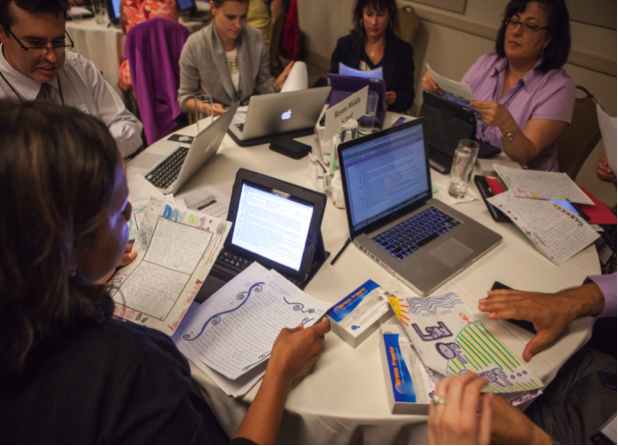
The Revere Middle School leadership team reviews student writing samples to identify student needs, refine research-based practices in the core curriculum, and develop appropriate interventions. Interventions that support the improvement of coursework are an integral part of an EWI system.
Lessons Learned
Involve school staff members with various perspectives (e.g., teachers, administrators, counselors, nurses). We learned so much about each student just by being in the same room together. By hearing what the nurse says about health, and what the dean says about discipline, and what the social worker says about home life, and what the teacher says about classroom behavior and participation, we could then assemble the puzzle pieces and work together to reach a student.
Talk to teammates about successes in their classrooms and share successes about building rapport. Through our EWI meetings, we brought teachers together to share strategies that were particularly helpful with specific students who presented a challenge for another teacher. We also identified patterns. Sometimes, teachers who had a student in the morning could tell when that student hadn’t taken his or her medicine, and the social worker could help the family find affordable medication or healthcare. Other times, teachers in the afternoon encountered difficulties with a student and later learned that student didn’t eat lunch that day.
Dig even deeper than what your EWI report tells you. If a student received 3 days of in-school suspension, ask why. Tardies? Disrespect? Fighting? Target those issues because often, when one thing improves, it has a positive impact on several other things.
Don’t “pile on” to the teachers’ workload. Frame the work in a positive light. By helping a student, they help their class and their fellow teachers. When assigning mentors, let the teachers choose their mentee students, so that teachers choose students with whom they have a positive relationship.
Learn More
Additional resources on early warning indicator systems are available in the Middle School Matters Clearinghouse. These resources can be further filtered by intended audience or resource type.
References
Allensworth, E. M., & Easton, J. Q. (2005). The on-track indicator as a predictor of high school graduation. Chicago, IL: University of Chicago Consortium on Chicago School Research.
Balfanz, R., Herzog, L., & Mac Iver, D. J. (2007). Preventing student disengagement and keeping students on the graduation path in urban middle-grades schools: Early identification and effective interventions. Educational Psychologist, 42(4), 223–235.
Balfanz, R., & Legters, N. (2004). Locating the dropout crisis. Which high schools produce the nation’s dropouts? Where are they located? Who attends them? (Report 70). Baltimore, MD: Center for Research on the Education of Students Placed at Risk.
Bruce, M., Bridgeland, J. M., Fox, J. H., & Balfanz, R. (2011). On track for success: The use of early warning indicator and intervention systems to build a grad nation. Washington, DC: Civic Enterprises & Everyone Graduates Center at Johns Hopkins University.
Mac Iver, M., & Mac Iver, D. (2009). Beyond the indicators: An integrated school-level approach to dropout prevention. Arlington, VA: George Washington University Center for Equity and Excellence in Education.
West, T. C. (2013). Just the right mix: Using an early warning indicators approach to identify potential dropouts across all grades. Baltimore, MD: Everyone Graduates Center at Johns Hopkins University.
This month, the Middle School Matters Institute Blog focuses on explicit, research-based vocabulary instruction, including the Frayer Model.
Contributors:
Deborah Reed, Ph.D., Florida Center for Reading Research, Florida State University (Research Perspective)
Priscilla Parhms, Uplift Mighty Preparatory, Uplift Education (Practice Perspective)
The Research Perspective
To read and learn from content area texts, middle school students must have knowledge of two types of vocabulary used in those texts (Townsend, Filippini, Collins, & Biancarosa, 2012). The first might be referred to as general academic terms (e.g., analysis, dissipate). These words have similar or related applications across subject areas and allow us to communicate ideas with greater sophistication and precision, as compared to our casual or conversational language. The other type of vocabulary important for learning in the middle grades is terms specific to particular disciplines (e.g., onomatopoeia, sliding friction). These words are labels for critical processes, literary elements or devices, and concepts that students might not encounter outside of a specific discipline. Even some words that seem familiar, such as grade or mine, have a completely different definition when applied within a content area class.
For successful learning within and across middle grades classes, students must know what these general and discipline-specific academic vocabulary words mean and know how to use them when reading, writing, and orally communicating in class. Students encounter thousands of new words each year, making vocabulary instruction all the more important.
Findings from research (Nagy & Townsend, 2012) suggest that effective vocabulary instruction includes two elements:
Strategies for learning words independently in the context of text
Direct teaching of terms that are critical for understanding content area lessons
It is important to note that the latter recommendation, explicitly teaching vocabulary, involves more than the traditional practice of assigning a list of terms at the start of a week or chapter, having students look up the definitions in a dictionary or glossary, and administering a test on the terms at the end of the week or chapter. Rather, explicit instruction that develops students’ academic vocabulary knowledge does the following:
Offers contextual and pragmatic information to make the words vivid (Vaughn et al., 2009)
Returns to the terms multiple times throughout a unit of instruction to deepen students’ understanding and reinforce their use of the terms (Lara-Alecio et al., 2012)
Engages students in discussion about how the terms are used in the text and how they give meaning to the concepts students are learning (Vaughn et al., 2013)
These practices align with Principle 2, Practice 1 of the Reading and Reading Interventions content dimension of the Middle School Matters Field Guide and Research Platform: “Provide explicit instruction of important words.”
The Frayer Model: Background
One instructional activity that combines the above features is referred to as the Frayer Model (Frayer, Frederick, & Klausmeier, 1969). This theoretically derived framework for directly teaching words to support concept development originally had seven steps:
Give the word and name its relevant attributes.
Eliminate irrelevant attributes.
Give examples.
Give examples of what the word is not (nonexamples).
List subordinate terms.
List superordinate terms.
List coordinate terms.
These steps were a schema for both learning an advanced concept and assessing knowledge of the concept. Early research on the Frayer Model did not involve a graphic organizer, as is commonly used today. Ninth-grade students identified as good and poor readers were randomly assigned to learn social studies content either with the typical textbook lessons or lessons constructed around the Frayer Model steps (Peters, 1974–1975). Results revealed a statistically significant difference in concept comprehension performance, favoring the Frayer Model condition, for good and poor readers alike. This study was not thoroughly described, so it is difficult to determine whether it met more modern quality indicators for experimental research (Gersten et al., 2005).
This original model was later adapted by Graves (1985) for broader use in direct vocabulary instruction. The adaptation reduced the framework to six steps:
Define the concept and give its essential attributes.
Distinguish between the concept and similar concepts.
Give examples and explain why they are examples.
Give nonexamples and explain why they are nonexamples.
Ask students to distinguish between other examples and nonexamples given by the teacher and to explain why they are examples or nonexamples.
Ask students to present their own examples and nonexamples and discuss why they are examples or nonexamples.
This approach was tested with the inclusion of concept webs (graphic organizers that depict relationships between concepts) for learning mathematical vocabulary (Monroe & Pendergrass, 1997). Fourth-graders in the study were randomly assigned to receive only definitional information about the words or to participate in the Frayer Model condition, using the concept webs. Those in the Frayer Model condition recorded significantly more mathematical concepts from their lessons. Although the results are considered promising, the sample size of the study was small (58 students), and no standardized measures of vocabulary or content learning were administered.
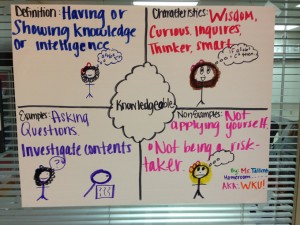
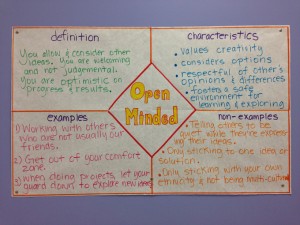
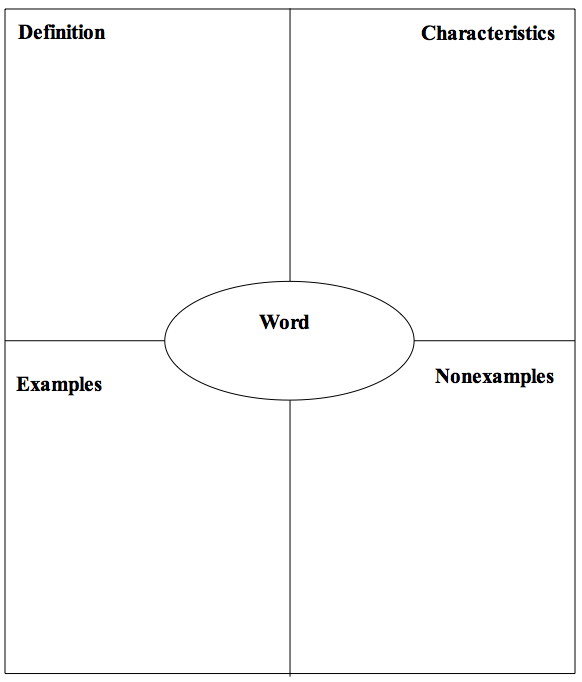
Eventually, the revised six steps of the Frayer Model were incorporated into a four-square graphic organizer (see Figure 1). Despite a wealth of anecdotal reports of its use, no research could be identified that specifically tested this particular format. However, it is consistent with the evidence-based practices for explicit vocabulary instruction outlined earlier as well as with the findings of meta-analyses supporting the use of graphic organizers for students with learning disabilities (Dexter & Hughes, 2011; Gajria, Jitendra, Sood, & Sacks, 2007).
The Frayer Model: Considerations for Use
To be effective, teachers need to be purposeful and deliberate when using the Frayer Model. Not all terms will lend themselves to the kind of multifaceted examination of attributes and applications that are part of the Frayer Model. For example, some terms do not have nonexamples. Others do not have examples that are distinguishable from the characteristics. Teachers need to complete the graphic organizer themselves to determine whether to implement the Frayer Model with a given term. Consistent with the original intent (Frayer et al., 1969), the approach is best when teaching a more complex concept around which many words or related ideas cluster.
In addition, parts of the graphic organizer might be completed iteratively as students build and deepen their conceptual knowledge. At the opening of a unit, perhaps only basic definitional information is provided along with attempts to build background knowledge (upper-left box of Figure 1). As students begin reading, they can look for the characteristics of the term (upper-right box of Figure 1). When they have more experiences with the content and learn related ideas and concepts, students can return to the Frayer Model to provide examples and nonexamples (bottom-left and bottom-right boxes of Figure 1). Throughout the lesson, students need to discuss what they learn and how they think about the information they record on the graphic organizer. This suggested process of teaching with the Frayer Model aligns with the previously discussed evidence-based features of making the terms vivid (Vaughn et al., 2009), returning to the words multiple times throughout a unit of instruction (Lara-Alecio et al., 2012), and fostering discussion about the words and concepts students are learning (Vaughn et al., 2013).
Deborah Reed delivers professional development to schools attending the 2013 MSMI Summer Conference.
One of the Middle School Matters Institute (MSMI) Tier III schools, Uplift Mighty Preparatory, received a day of professional development focused on effective vocabulary and use of the Frayer Model. Below, Priscilla Parhms shares the school’s experience, successes, challenges, and lessons learned.
Reflections From the Field
In early July, armed with our MSMI Implementation Plan Template, we were ready to plan professional development for the Mighty staff. We had spent 3 awesome days at the MSMI Summer Conference and were ready to share that knowledge with the world. We were confident and excited about our own learning and development. We were prepared.
When we returned to Fort Worth from the MSMI Summer Conference, we spent days developing a basic literacy framework, and we knew explicit vocabulary instruction was a major part of that. There are many things that reading and language experts do not agree on, but teaching vocabulary is not one of them. Vocabulary instruction is an important part of reading and language arts classes, as well as content area classes such as science and humanities. Explicit vocabulary instruction can help students learn the meaning of new words, increase their comprehension, and develop their ability to communicate effectively in a variety of formats. Helping students develop a strong vocabulary increases their capacity to read, write, discuss, present, and think. Vocabulary knowledge is a strong predictor of reading comprehension. To understand text, students must know what most of the words mean.
What we did not anticipate was the vast amount of graphic organizers and models that could be used to teach vocabulary. We reached out to MSMI to lead professional development for our core academic teachers in explicit vocabulary instruction during our scheduled Tier III site visit. With the guidance of Dr. Deborah Reed, we chose the Frayer Model as the strategy that the entire staff would use.
Frazer Model Example
Our Goals
Our major goal at Uplift Mighty is to develop students, putting them on the path to college readiness by the time they enter high school. We needed a common literacy framework that emphasized vocabulary instruction in all content areas and that set the purpose and direction for a balanced and comprehensive literacy program to ensure that all students achieve proficiency in listening, speaking, reading, and writing. Academic vocabulary and language are critical components of college readiness. Engaging all teachers in professional development to build their capacity to use the Frayer Model to teach vocabulary was another goal. We also wanted to increase our scholars’ trajectory toward college readiness, as measured by the State of Texas Assessments of Academic Readiness (STAAR) and Measures of Academic Progress (MAP).
Our Challenges
Initially, the staff was excited about using the Frayer Model. This initial excitement soon wore off, and teachers went back to teaching vocabulary in myriad ways. We were no longer using a single strategy for vocabulary instruction, causing confusion for scholars and staff alike. We had to remind teachers why it was important to provide repeated exposure to words through an explicit vocabulary instructional strategy. In short, our goal was for the Frayer Model to do the following:
Help our scholars understand key words and concepts
Prompt scholars to provide definitions, facts or characteristics, examples, and nonexamples
Lead scholars to a deeper understanding of words and their relationship to students’ lives
We also soon realized that even though teachers had been trained in using the three categories of words (Tier I, Tier II, and Tier III words), they had a difficult time choosing which words to teach, especially in the content areas.
Teachers also perceived explicit vocabulary instruction as being time consuming, thinking they did not have enough time to use the Frayer Model. We had to refocus teachers on the belief that teaching reading strategies was everyone’s job. We had to continue to work on teaching scholars to become independent vocabulary learners.
Our Success
All scholars on campus have been taught to use the Frayer Model. All core teachers are dedicating part of their class time to explicitly teach academic vocabulary. Making certain that students are familiar with the vocabulary they will encounter in reading selections has made the reading task easier.
As a staff, we have learned to be patient and strategic about which vocabulary words we teach. Teachers provide scholars with repeated exposures to new words in multiple oral and written contexts and sufficient practice sessions.
Our scholars are beginning to learn a range of productive meanings for vocabulary words and the correct way to use those words—beyond simply being able to recognize them in print.
Lessons Learned
Build a sense of urgency: To nudge teachers out of their comfort zone and help them embrace change, schools must share data to show teachers that the way they previously taught vocabulary was not effective.
Provide training and ample time: To become knowledgeable and accepting, teachers need multiple opportunities to ask questions, see examples, and practice.
Chart key behaviors that indicate progress: This charting helps everyone understand the expectations.
Be patient: Don’t try to do too much too quickly. For example, we started with the English language arts and humanities teachers and branched out to science and mathematics teachers. We then introduced the Frayer Model to our special area teachers, including PE teachers.
Celebrate early adopters: After completing classroom observations, celebrate teachers who continue to successfully use the Frayer Model.
Inspect what you expect: When the Frayer Model becomes a priority of the leadership team, it becomes a priority of the staff.
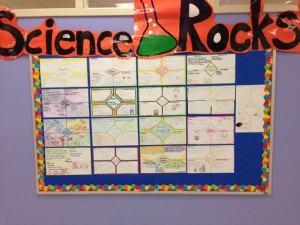
Student-created Frayer Models for science instruction.Figure 1. Frayer Model graphic organizer
Learn More
To learn more about research-based vocabulary instruction, explore the following resources, organized below by primary audience:
Additional resources on vocabulary instruction are available in the Middle School Matters Clearinghouse. These resources can be filtered by intended audience or resource type.
References
Dexter, D. D., & Hughes, C. A. (2011). Graphic organizers and students with learning disabilities: A meta-analysis. Learning Disabilities Quarterly, 34, 51–72.
Frayer, D., Frederick, W., & Klausmeier, H. (1969). A schema for testing the level of concept mastery. Madison, WI: Wisconsin Center for Education.
Gajria, M., Jitendra, A. K., Sood, S., & Sacks, G. (2007). Improving comprehension of expository texts in students with LD: A research synthesis. Journal of Learning Disabilities, 40, 210–227. doi:10.1177/00222194070400030301
Gersten, R., Fuchs, L. S., Compton, D., Coyne, M., Greenwood, C., & Innocenti, M. S. (2005). Quality indicators for group experimental and quasi-experimental research in special education. Exceptional Children, 71, 149–164.
Graves, M. R. (1985). A word is a word . . . or is it? New York, NY: Scholastic.
Lara-Alecio, R., Tong, F., Irby, B. J., Guerrero, C., Huerta, M., & Fan, Y. (2012). The effect of instructional intervention on middle school English learners’ science and English reading achievement. Journal of Research in Science Teaching, 49, 987–1011. doi:10.1002/tea.21031
Monroe, E. E., & Pendergrass, M. R. (1997). Effects of mathematical vocabulary instruction on fourth grade students. Reading Improvement, 34(3), 120–132.
Nagy, W. E., & Townsend, D. (2012). Words as tools: Learning academic vocabulary as language acquisition. Reading Research Quarterly, 47, 91–108. doi:10.1002/RRQ.011
Peters, C. W. (1974–1975). A comparison between the Frayer Model of concept attainment and the textbook approach to concept attainment. Reading Research Quarterly, 10, 252–254.
Townsend, D., Filippini, A., Collins, P., & Biancarosa, G. (2012). Evidence for the importance of academic word knowledge for the academic achievement of diverse middle school students. Elementary School Journal, 112, 497–518. doi:10.1086/663301
Vaughn, S., Martinez, L. R., Linan-Thompson, S., Reutebuch, C. K., Carlson, C. D., & Francis, D. J. (2009). Enhancing social studies vocabulary and comprehension for seventh-grade English language learners: Findings from two experimental studies. Journal of Research on Educational Effectiveness, 2(4), 297–324.
Vaughn, S., Swanson, E. A., Roberts, G., Wanzek, J., Stillman-Spisak, S. J., Solis, M., & Simmons, D. (2013). Improving reading comprehension and social studies knowledge in middle school. Reading Research Quarterly, 48, 77–93. doi:10.1002/rrq.039
This is an example of a WordPress post, you could edit this to put information about yourself or your site so readers know where you are coming from. You can create as many posts as you like in order to share with your readers what is on your mind.
This is an example of a WordPress post, you could edit this to put information about yourself or your site so readers know where you are coming from. You can create as many posts as you like in order to share with your readers what is on your mind. This is an example of a WordPress post, you could edit this to put information about yourself or your site so readers know where you are coming from. You can create as many posts as you like in order to share with your readers what is on your mind.
This is an example of a WordPress post, you could edit this to put information about yourself or your site so readers know where you are coming from. You can create as many posts as you like in order to share with your readers what is on your mind.
This is an example of a WordPress post, you could edit this to put information about yourself or your site so readers know where you are coming from. You can create as many posts as you like in order to share with your readers what is on your mind. This is an example of a WordPress post, you could edit this to put information about yourself or your site so readers know where you are coming from. You can create as many posts as you like in order to share with your readers what is on your mind.
This is an example of a WordPress post, you could edit this to put information about yourself or your site so readers know where you are coming from. You can create as many posts as you like in order to share with your readers what is on your mind.
This is an example of a WordPress post, you could edit this to put information about yourself or your site so readers know where you are coming from. You can create as many posts as you like in order to share with your readers what is on your mind. This is an example of a WordPress post, you could edit this to put information about yourself or your site so readers know where you are coming from. You can create as many posts as you like in order to share with your readers what is on your mind.
This is an example of a WordPress post, you could edit this to put information about yourself or your site so readers know where you are coming from. You can create as many posts as you like in order to share with your readers what is on your mind.
This is an example of a WordPress post, you could edit this to put information about yourself or your site so readers know where you are coming from. You can create as many posts as you like in order to share with your readers what is on your mind. This is an example of a WordPress post, you could edit this to put information about yourself or your site so readers know where you are coming from. You can create as many posts as you like in order to share with your readers what is on your mind.
 The room at Erie’s Roosevelt Middle School is called the “data room” for good reason. The walls are covered with color-coded cards detailing everything a teacher might need to know about students at risk for dropping out of school: their attendance, their behavior and the courses they’re failing. But that’s about to change. Soon the school will trade in the cards for the Opening Doors Early Warning System, a computer-based “dashboard” that…