This installment of the Middle School Matters Institute Blog focuses on establishing and enhancing performance management to foster data-driven decision-making.
Contributors:
Dixie Knight, eMetric LLC (Research Perspective)
Katie Wilke, Ann Richards Middle School, Dallas Independent School District (Practice Perspective)
The Research Perspective
Getting Started With Performance Management
Preparing all students for success in college, career, and life is a motto I often hear and see on posters hanging throughout hallways in many schools. This is a lofty mission that often leads to the adoption of one improvement methodology after another. Too often, any change resulting from such initiatives is isolated, short-lived, or too ill-defined to scale schoolwide. Principals, teachers, and other stakeholders are left wondering why these efforts failed to deliver on their promises.
Performance management is more than a methodology. It’s more than a data reporting system, and it’s more than professional development to help educators become “data-driven decision-makers.” Although those resources are critical to the effective use of data, alone they are often insufficient to produce sustained, significant improvement in student outcomes. Performance management provides an overarching framework that integrates and aligns these methodologies, data systems, and practices to help educators gain deeper insight into student performance, into trends and gaps, and into what is working and what is not. The whole is indeed greater than the sum of its parts!
In one sense, the concept of aligning effort and resources to do one thing—help students succeed—seems simple and straightforward. However, my experiences as a teacher and school district administrator remind me that this act does not come naturally! It requires a shared vision, a schoolwide culture of basing decisions and actions on information and evidence, and continuous monitoring of progress to make adjustments as needed. In such a performance-driven environment, all educators agree on what the goals are, have ready access to appropriate data and tools, and are empowered to and held accountable for improving student performance. In essence, the alignment of these typically disconnected resources and practices guides staff to doing the right things right.
As defined in the MSM Field Guide and Research Platform, the term “performance management” refers to an approach to building the capacity of educators at all levels to use data to prioritize activities that advance core goals, measure progress toward meeting those goals, and make informed decisions regarding the best ways to improve student achievement. Despite the attention and funding data use has received over the last decade, high-quality, rigorous research into the effectiveness of a performance management approach to student improvement is sparse and fragmented. The six performance management principles and their accompanying practices in the MSM Field Guide are, however, based on a large supply of case studies from both the private and public sectors, along with professional opinions of practitioners and researchers who have experienced or witnessed meaningful, sustained improvement in performance-driven schools and districts. Within the MSM Research Platform, performance management serves as a foundational pillar to support the effective implementation of the other content dimensions and to provide a feedback loop for ongoing improvement.
Establishing and Communicating a Vision for Schoolwide Data Use
The practice guide Using Student Achievement Data to Support Instructional Decision Making, by the Institute of Education Sciences What Works Clearinghouse, provides recommendations for using data effectively to inform instructional decisions. The guide suggests that leaders must establish a strong culture of data use to ensure that data-based decision-making is consistent and effective. By defining and communicating norms and expectations for using data to improve student performance, leaders can take the first critical step to implementing performance management in their school and begin the journey of building the capacity of all educators to use data to inform decisions and guide actions for continuous improvement of student outcomes.


The MSM Field Guide provides the following practices in Principle 1 to help middle grade leaders establish and communicate a strong vision for schoolwide data use.
Practice 1: The principal establishes a schoolwide data team with ongoing responsibility for promoting and ensuring effective data use.
Although managing student performance is a shared responsibility, a small team of people responsible for organizing and preparing data and modeling and promoting the effective use of data can move the vision forward. A cross-functional team, with membership representing classroom teachers, special populations, technology professionals, and curriculum specialists, can ensure that the needs and context of the whole school system are considered. The data use team is also instrumental in creating an environment that encourages and rewards open, honest reflection and dialogue. The insight provided by data isn’t always a pretty picture! Trust among colleagues and school leadership is a necessity to cultivating a culture where all educators, by habit, use data to effect positive change.
Practice 2: Develop a data-use plan that articulates activities, roles, and responsibilities.
One of the first tasks this team should tackle is developing a well-articulated plan for how data will be used to inform decisions and actions. The plan should identify the types of data to be used, determine the frequency of review to document progress toward goals, link data to actions or strategies implemented, and set a process to determine the need for interventions. Roles and responsibilities for monitoring specific data should be clearly articulated.
Practice 3: Develop common understanding of key terminology among all data users.
The data team should also define key terms to be used in data conversations and reports. During data team meetings, members should discuss key terms in appropriate contexts to ensure common understanding of words, goals, and data. In conversations with teachers and staff, data team members and school leaders should use these terms consistently to check for understanding and encourage others to do the same.
By aligning effort and resources aimed at data use, middle grade leaders can ensure that systems, processes, and people work together efficiently and effectively to prepare all students for success in college, careers, and beyond.
Below, Ann Richards Middle School, a Middle School Matters Institute “Tier II” school, describes its experience with implementing the three practices described above to establish a performance management system.
Reflections From the Field
Performance Management: Our Mirror
“Your school is a reflection of you.” Mr. Hise, principal of Ann Richards Middle School (ARMS), pauses after sharing this quote during a weekly staff development meeting. The moment clearly resonates with each teacher in the room. The silence is fleeting and collaborative lesson planning quickly ensues, but the words stick.
Performance management feels ambitious and consuming, yet logical. It requires faculty and staff members to examine metrics consistently, reflecting on their practices. The metrics and measures we examine are a representation of our school, and therefore they are a direct reflection of our instructional effectiveness. We must examine our reflection in the mirror.

At ARMS, there is a deep-seated belief in the importance of examining our true, and often harsh, reality through data. To improve student achievement and create college- and career-ready students, we must continually improve instruction, monitor progress, and evaluate our effectiveness. We must take a good, hard, long look in that mirror.
Our Goals: Changing Our Reflection
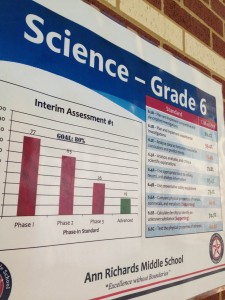
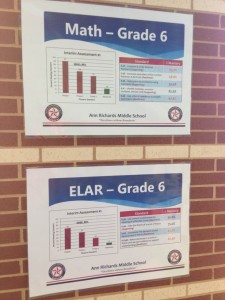
At ARMS, our goal is to create a culture of data-driven decisions for student improvement. We aim to establish a schoolwide data team and develop a data-use plan that uses common terminology. Our campus reviews lagging data and creates content goals in response. Engaging the entire staff in professional development, we will build capacity for investigating data and providing appropriate interventions and support for students. We also strive to connect our work on data to our simultaneous focus on the Habits of Mind.

Our Challenges: Disliking Our Reflection
Challenges often arise when educators don’t want to look in the mirror. The mirror’s reflection, or data, poses a challenging truth; as a result, excuses can become the norm. The three practices outlined in Performance Management Principle 1 (as described above by Ms. Knight) helped our campus to build a common goal and foundation for evidence-based decision-making. We have discovered that to deepen this commitment, we need to celebrate teachers when data-informed decisions have proven effective.
It is challenging to make students aware of their progress and to fully integrate them into the culture of data-driven instruction. The challenge lies in outlining the assessed curriculum in student-friendly and concise terms, so students are aware of what they are responsible for learning. Furthermore, providing time for students to evaluate their progress toward mastery of the curriculum has proven challenging. To support and encourage teacher and student discussions focused on data and feedback, we have implemented Student Advocacy Management (SAM) on our campus. SAM, a newly implemented district initiative, has been customized and tailored to meet our campus’ needs. Using a student-friendly reflection chart, staff members are provided a framework for data conversations with SAM students. The document encourages students to identify areas of growth based on their data, set goals, and work with a staff member to monitor their progress. If proven effective, our goal is to use this process to engage parents and community members.
Our Success: Enjoying Our Reflection
Although the SAM process specifically addresses our needs in one area, we have also used its data to successfully address the social and emotional needs of our students. During the first few months of school, pod leaders used attendance, behavior, and course performance data to identify our at-risk population. Strategically analyzing these data allows us to purposefully target individual students.
Schoolwide dedication to performance management also requires campus leadership to continuously exhibit the practices in Performance Management Principle 3. At ARMS, we have found great success in providing targeted professional development and support for teachers through our five instructional coaches and administrative team. Teachers now exhibit confidence during data conversations and collaboration.
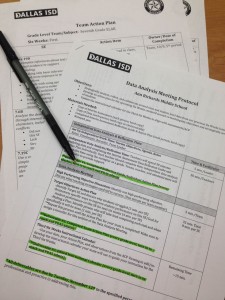
Finally, our protocols and reflection guides yield great benefits. Teachers begin by completing an individual analysis and reflection guide. Examining their own classroom’s reflection, the teacher identifies the four highest-priority standards, considers why these knowledge gaps exist, and considers various instructional practices for improvement. The content or grade-level teams reconvene to develop a specific, goal-focused action plan. The protocol (40-minute protocol or 90-minute protocol) is swift, providing each teacher specified amounts of time to share their struggles and brainstorm ways to improve instruction. Using that action plan, the teachers revise instructional calendars, collaborate to reteach lessons, and develop common quizzes or tests. The instructional coach facilitates the discussion, provides resources, and lends support where needed. This structured approach builds capacity in all participants while maintaining focus on the topic: changing our reflection.
Lessons Learned: Polishing the Mirror
- When the reflection doesn’t change, we must. When data are stagnant, we must respond with urgency and perseverance. Though data analysis can feel personal, it is simply a factual representation of where we stand. If we don’t like where we stand, we must modify our instruction.
- Show the community your reflection. Parents and guardians, as well as students, must receive guidance and support in understanding assessments and goals. The community is an integral part of our students’ lives and a key part of raising student achievement.
- Be patient when the reflection is blurry. Provide protected time for teachers to collaborate and interpret data. Continuously build teachers’ capacity to analyze and understand data.
- Celebrate! Even if celebrating the simple fact of making incremental steps in establishing performance management in our schools, we must create an optimistic culture around performance management.

Learn More
MSMI Clearinghouse
Many resources on implementing a performance management system are available in the Middle School Matters Institute Clearinghouse. These resources can be further filtered by intended audience or resource type.
ARMS Data Meeting Materials
 We have an update on the new “Middle School Matters” initiative at Roosevelt Middle School. We were first to tell you in August, that Roosevelt is one of three schools nationwide chosen by the Bush Institute to receive special resources and development. We went back to Roosevelt today, where students had the day off, and the teachers were doing the learning. Those doing the training, are from the Meadows Center for preventing educational risk at…
 When Lindale Junior High School Principal Vicki Thrasher applied for a program that would give her campus free, expert-level professional support, the interviewers had one key question: Why? Lindale Junior High performed as well on the 2013 accountability ratings, meeting the state’s standard and earning all three academic distinctions. From the outsider’s view, it’s a school that’s in little need of help. So why apply for it? “We…