Delivering Explicit Vocabulary Instruction: Using the Frayer Model

This month, the Middle School Matters Institute Blog focuses on explicit, research-based vocabulary instruction, including the Frayer Model.

Contributors:
Deborah Reed, Ph.D., Florida Center for Reading Research, Florida State University (Research Perspective)
Priscilla Parhms, Uplift Mighty Preparatory, Uplift Education (Practice Perspective)


The Research Perspective

To read and learn from content area texts, middle school students must have knowledge of two types of vocabulary used in those texts (Townsend, Filippini, Collins, & Biancarosa, 2012). The first might be referred to as general academic terms (e.g., analysis, dissipate). These words have similar or related applications across subject areas and allow us to communicate ideas with greater sophistication and precision, as compared to our casual or conversational language. The other type of vocabulary important for learning in the middle grades is terms specific to particular disciplines (e.g., onomatopoeia, sliding friction). These words are labels for critical processes, literary elements or devices, and concepts that students might not encounter outside of a specific discipline. Even some words that seem familiar, such as grade or mine, have a completely different definition when applied within a content area class.

For successful learning within and across middle grades classes, students must know what these general and discipline-specific academic vocabulary words mean and know how to use them when reading, writing, and orally communicating in class. Students encounter thousands of new words each year, making vocabulary instruction all the more important.

Findings from research (Nagy & Townsend, 2012) suggest that effective vocabulary instruction includes two elements:

  1.  Strategies for learning words independently in the context of text
  2. Direct teaching of terms that are critical for understanding content area lessons

It is important to note that the latter recommendation, explicitly teaching vocabulary, involves more than the traditional practice of assigning a list of terms at the start of a week or chapter, having students look up the definitions in a dictionary or glossary, and administering a test on the terms at the end of the week or chapter. Rather, explicit instruction that develops students’ academic vocabulary knowledge does the following:

  • Offers contextual and pragmatic information to make the words vivid (Vaughn et al., 2009)
  • Returns to the terms multiple times throughout a unit of instruction to deepen students’ understanding and reinforce their use of the terms (Lara-Alecio et al., 2012)
  • Engages students in discussion about how the terms are used in the text and how they give meaning to the concepts students are learning (Vaughn et al., 2013)

These practices align with Principle 2, Practice 1 of the Reading and Reading Interventions content dimension of the Middle School Matters Field Guide and Research Platform: “Provide explicit instruction of important words.”

The Frayer Model: Background

One instructional activity that combines the above features is referred to as the Frayer Model (Frayer, Frederick, & Klausmeier, 1969). This theoretically derived framework for directly teaching words to support concept development originally had seven steps:

  1. Give the word and name its relevant attributes.
  2. Eliminate irrelevant attributes.
  3. Give examples.
  4. Give examples of what the word is not (nonexamples).
  5. List subordinate terms.
  6. List superordinate terms.
  7. List coordinate terms.

These steps were a schema for both learning an advanced concept and assessing knowledge of the concept. Early research on the Frayer Model did not involve a graphic organizer, as is commonly used today. Ninth-grade students identified as good and poor readers were randomly assigned to learn social studies content either with the typical textbook lessons or lessons constructed around the Frayer Model steps (Peters, 1974–1975). Results revealed a statistically significant difference in concept comprehension performance, favoring the Frayer Model condition, for good and poor readers alike. This study was not thoroughly described, so it is difficult to determine whether it met more modern quality indicators for experimental research (Gersten et al., 2005).

This original model was later adapted by Graves (1985) for broader use in direct vocabulary instruction. The adaptation reduced the framework to six steps:

  1. Define the concept and give its essential attributes.
  2. Distinguish between the concept and similar concepts.
  3. Give examples and explain why they are examples.
  4. Give nonexamples and explain why they are nonexamples.
  5. Ask students to distinguish between other examples and nonexamples given by the teacher and to explain why they are examples or nonexamples.
  6. Ask students to present their own examples and nonexamples and discuss why they are examples or nonexamples.

This approach was tested with the inclusion of concept webs (graphic organizers that depict relationships between concepts) for learning mathematical vocabulary (Monroe & Pendergrass, 1997). Fourth-graders in the study were randomly assigned to receive only definitional information about the words or to participate in the Frayer Model condition, using the concept webs. Those in the Frayer Model condition recorded significantly more mathematical concepts from their lessons. Although the results are considered promising, the sample size of the study was small (58 students), and no standardized measures of vocabulary or content learning were administered.

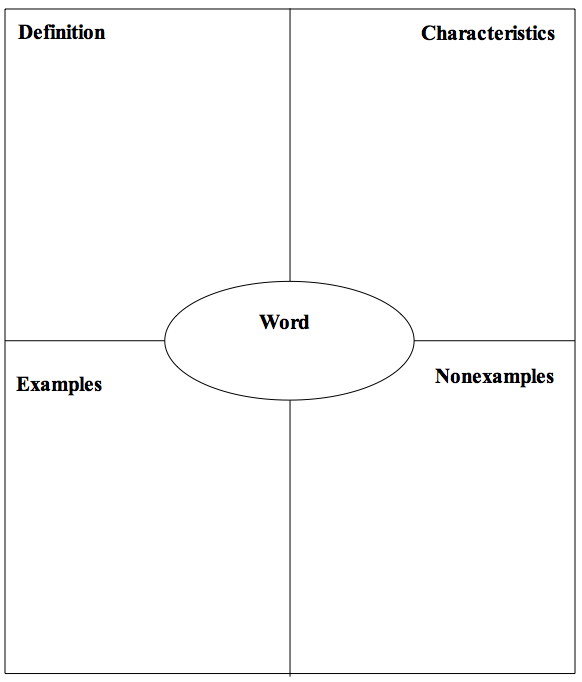
Eventually, the revised six steps of the Frayer Model were incorporated into a four-square graphic organizer (see Figure 1). Despite a wealth of anecdotal reports of its use, no research could be identified that specifically tested this particular format. However, it is consistent with the evidence-based practices for explicit vocabulary instruction outlined earlier as well as with the findings of meta-analyses supporting the use of graphic organizers for students with learning disabilities (Dexter & Hughes, 2011; Gajria, Jitendra, Sood, & Sacks, 2007).

The Frayer Model: Considerations for Use

To be effective, teachers need to be purposeful and deliberate when using the Frayer Model. Not all terms will lend themselves to the kind of multifaceted examination of attributes and applications that are part of the Frayer Model. For example, some terms do not have nonexamples. Others do not have examples that are distinguishable from the characteristics. Teachers need to complete the graphic organizer themselves to determine whether to implement the Frayer Model with a given term. Consistent with the original intent (Frayer et al., 1969), the approach is best when teaching a more complex concept around which many words or related ideas cluster.

In addition, parts of the graphic organizer might be completed iteratively as students build and deepen their conceptual knowledge. At the opening of a unit, perhaps only basic definitional information is provided along with attempts to build background knowledge (upper-left box of Figure 1). As students begin reading, they can look for the characteristics of the term (upper-right box of Figure 1). When they have more experiences with the content and learn related ideas and concepts, students can return to the Frayer Model to provide examples and nonexamples (bottom-left and bottom-right boxes of Figure 1). Throughout the lesson, students need to discuss what they learn and how they think about the information they record on the graphic organizer. This suggested process of teaching with the Frayer Model aligns with the previously discussed evidence-based features of making the terms vivid (Vaughn et al., 2009), returning to the words multiple times throughout a unit of instruction (Lara-Alecio et al., 2012), and fostering discussion about the words and concepts students are learning (Vaughn et al., 2013).
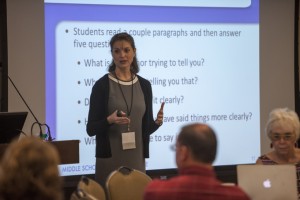
Deborah Reed delivers professional development to schools attending the 2013 MSMI Summer Conference.

One of the Middle School Matters Institute (MSMI) Tier III schools, Uplift Mighty Preparatory, received a day of professional development focused on effective vocabulary and use of the Frayer Model. Below, Priscilla Parhms shares the school’s experience, successes, challenges, and lessons learned.

Reflections From the Field

In early July, armed with our MSMI Implementation Plan Template, we were ready to plan professional development for the Mighty staff. We had spent 3 awesome days at the MSMI Summer Conference and were ready to share that knowledge with the world. We were confident and excited about our own learning and development. We were prepared.

When we returned to Fort Worth from the MSMI Summer Conference, we spent days developing a basic literacy framework, and we knew explicit vocabulary instruction was a major part of that. There are many things that reading and language experts do not agree on, but teaching vocabulary is not one of them. Vocabulary instruction is an important part of reading and language arts classes, as well as content area classes such as science and humanities. Explicit vocabulary instruction can help students learn the meaning of new words, increase their comprehension, and develop their ability to communicate effectively in a variety of formats. Helping students develop a strong vocabulary increases their capacity to read, write, discuss, present, and think. Vocabulary knowledge is a strong predictor of reading comprehension. To understand text, students must know what most of the words mean.

What we did not anticipate was the vast amount of graphic organizers and models that could be used to teach vocabulary. We reached out to MSMI to lead professional development for our core academic teachers in explicit vocabulary instruction during our scheduled Tier III site visit. With the guidance of Dr. Deborah Reed, we chose the Frayer Model as the strategy that the entire staff would use.
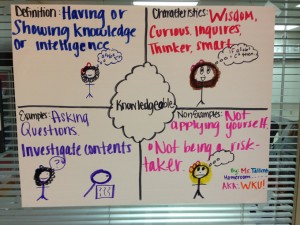
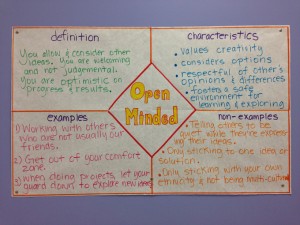
Frazer Model Example

mar14_03

Our Goals

Our major goal at Uplift Mighty is to develop students, putting them on the path to college readiness by the time they enter high school. We needed a common literacy framework that emphasized vocabulary instruction in all content areas and that set the purpose and direction for a balanced and comprehensive literacy program to ensure that all students achieve proficiency in listening, speaking, reading, and writing. Academic vocabulary and language are critical components of college readiness. Engaging all teachers in professional development to build their capacity to use the Frayer Model to teach vocabulary was another goal. We also wanted to increase our scholars’ trajectory toward college readiness, as measured by the State of Texas Assessments of Academic Readiness (STAAR) and Measures of Academic Progress (MAP).

Our Challenges

Initially, the staff was excited about using the Frayer Model. This initial excitement soon wore off, and teachers went back to teaching vocabulary in myriad ways. We were no longer using a single strategy for vocabulary instruction, causing confusion for scholars and staff alike. We had to remind teachers why it was important to provide repeated exposure to words through an explicit vocabulary instructional strategy. In short, our goal was for the Frayer Model to do the following:

  • Help our scholars understand key words and concepts
  • Prompt scholars to provide definitions, facts or characteristics, examples, and nonexamples
  • Lead scholars to a deeper understanding of words and their relationship to students’ lives

We also soon realized that even though teachers had been trained in using the three categories of words (Tier I, Tier II, and Tier III words), they had a difficult time choosing which words to teach, especially in the content areas.

Teachers also perceived explicit vocabulary instruction as being time consuming, thinking they did not have enough time to use the Frayer Model. We had to refocus teachers on the belief that teaching reading strategies was everyone’s job. We had to continue to work on teaching scholars to become independent vocabulary learners.

Our Success

All scholars on campus have been taught to use the Frayer Model. All core teachers are dedicating part of their class time to explicitly teach academic vocabulary. Making certain that students are familiar with the vocabulary they will encounter in reading selections has made the reading task easier.

As a staff, we have learned to be patient and strategic about which vocabulary words we teach. Teachers provide scholars with repeated exposures to new words in multiple oral and written contexts and sufficient practice sessions.

Our scholars are beginning to learn a range of productive meanings for vocabulary words and the correct way to use those words—beyond simply being able to recognize them in print.

Lessons Learned

  • Build a sense of urgency: To nudge teachers out of their comfort zone and help them embrace change, schools must share data to show teachers that the way they previously taught vocabulary was not effective.
  • Provide training and ample time: To become knowledgeable and accepting, teachers need multiple opportunities to ask questions, see examples, and practice.
  • Chart key behaviors that indicate progress: This charting helps everyone understand the expectations.
  • Be patient: Don’t try to do too much too quickly. For example, we started with the English language arts and humanities teachers and branched out to science and mathematics teachers. We then introduced the Frayer Model to our special area teachers, including PE teachers.
  • Celebrate early adopters: After completing classroom observations, celebrate teachers who continue to successfully use the Frayer Model.
  • Inspect what you expect: When the Frayer Model becomes a priority of the leadership team, it becomes a priority of the staff.
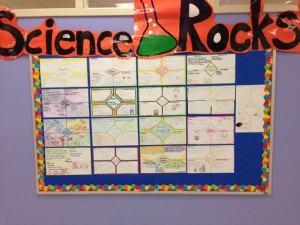
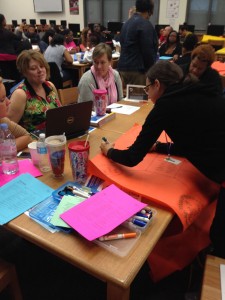
Student-created Frayer Models for science instruction.
Frayer Model graphic organizer
Figure 1. Frayer Model graphic organizer

Learn More

To learn more about research-based vocabulary instruction, explore the following resources, organized below by primary audience:

Additional resources on vocabulary instruction are available in the Middle School Matters Clearinghouse. These resources can be filtered by intended audience or resource type.

References

Dexter, D. D., & Hughes, C. A. (2011). Graphic organizers and students with learning disabilities: A meta-analysis. Learning Disabilities Quarterly, 34, 51–72.

Frayer, D., Frederick, W., & Klausmeier, H. (1969). A schema for testing the level of concept mastery. Madison, WI: Wisconsin Center for Education.

Gajria, M., Jitendra, A. K., Sood, S., & Sacks, G. (2007). Improving comprehension of expository texts in students with LD: A research synthesis. Journal of Learning Disabilities, 40, 210–227. doi:10.1177/00222194070400030301

Gersten, R., Fuchs, L. S., Compton, D., Coyne, M., Greenwood, C., & Innocenti, M. S. (2005). Quality indicators for group experimental and quasi-experimental research in special education. Exceptional Children, 71, 149–164.

Graves, M. R. (1985). A word is a word . . . or is it? New York, NY: Scholastic.
Lara-Alecio, R., Tong, F., Irby, B. J., Guerrero, C., Huerta, M., & Fan, Y. (2012). The effect of instructional intervention on middle school English learners’ science and English reading achievement. Journal of Research in Science Teaching, 49, 987–1011. doi:10.1002/tea.21031

Monroe, E. E., & Pendergrass, M. R. (1997). Effects of mathematical vocabulary instruction on fourth grade students. Reading Improvement, 34(3), 120–132.

Nagy, W. E., & Townsend, D. (2012). Words as tools: Learning academic vocabulary as language acquisition. Reading Research Quarterly, 47, 91–108. doi:10.1002/RRQ.011

Peters, C. W. (1974–1975). A comparison between the Frayer Model of concept attainment and the textbook approach to concept attainment. Reading Research Quarterly, 10, 252–254.

Townsend, D., Filippini, A., Collins, P., & Biancarosa, G. (2012). Evidence for the importance of academic word knowledge for the academic achievement of diverse middle school students. Elementary School Journal, 112, 497–518. doi:10.1086/663301

Vaughn, S., Martinez, L. R., Linan-Thompson, S., Reutebuch, C. K., Carlson, C. D., & Francis, D. J. (2009). Enhancing social studies vocabulary and comprehension for seventh-grade English language learners: Findings from two experimental studies. Journal of Research on Educational Effectiveness, 2(4), 297–324.

Vaughn, S., Swanson, E. A., Roberts, G., Wanzek, J., Stillman-Spisak, S. J., Solis, M., & Simmons, D. (2013). Improving reading comprehension and social studies knowledge in middle school. Reading Research Quarterly, 48, 77–93. doi:10.1002/rrq.039
Performance Management: Identifying Critical First Steps for Schools

This installment of the Middle School Matters Institute Blog focuses on establishing and enhancing performance management to foster data-driven decision-making.

Contributors:
Dixie Knight, eMetric LLC (Research Perspective)
Katie Wilke, Ann Richards Middle School, Dallas Independent School District (Practice Perspective)


The Research Perspective

Getting Started With Performance Management

Preparing all students for success in college, career, and life is a motto I often hear and see on posters hanging throughout hallways in many schools. This is a lofty mission that often leads to the adoption of one improvement methodology after another. Too often, any change resulting from such initiatives is isolated, short-lived, or too ill-defined to scale schoolwide. Principals, teachers, and other stakeholders are left wondering why these efforts failed to deliver on their promises.

Performance management is more than a methodology. It’s more than a data reporting system, and it’s more than professional development to help educators become “data-driven decision-makers.” Although those resources are critical to the effective use of data, alone they are often insufficient to produce sustained, significant improvement in student outcomes. Performance management provides an overarching framework that integrates and aligns these methodologies, data systems, and practices to help educators gain deeper insight into student performance, into trends and gaps, and into what is working and what is not. The whole is indeed greater than the sum of its parts!

In one sense, the concept of aligning effort and resources to do one thing—help students succeed—seems simple and straightforward. However, my experiences as a teacher and school district administrator remind me that this act does not come naturally! It requires a shared vision, a schoolwide culture of basing decisions and actions on information and evidence, and continuous monitoring of progress to make adjustments as needed. In such a performance-driven environment, all educators agree on what the goals are, have ready access to appropriate data and tools, and are empowered to and held accountable for improving student performance. In essence, the alignment of these typically disconnected resources and practices guides staff to doing the right things right.

As defined in the MSM Field Guide and Research Platform, the term “performance management” refers to an approach to building the capacity of educators at all levels to use data to prioritize activities that advance core goals, measure progress toward meeting those goals, and make informed decisions regarding the best ways to improve student achievement. Despite the attention and funding data use has received over the last decade, high-quality, rigorous research into the effectiveness of a performance management approach to student improvement is sparse and fragmented. The six performance management principles and their accompanying practices in the MSM Field Guide are, however, based on a large supply of case studies from both the private and public sectors, along with professional opinions of practitioners and researchers who have experienced or witnessed meaningful, sustained improvement in performance-driven schools and districts. Within the MSM Research Platform, performance management serves as a foundational pillar to support the effective implementation of the other content dimensions and to provide a feedback loop for ongoing improvement.

Establishing and Communicating a Vision for Schoolwide Data Use

The practice guide Using Student Achievement Data to Support Instructional Decision Making, by the Institute of Education Sciences What Works Clearinghouse, provides recommendations for using data effectively to inform instructional decisions. The guide suggests that leaders must establish a strong culture of data use to ensure that data-based decision-making is consistent and effective. By defining and communicating norms and expectations for using data to improve student performance, leaders can take the first critical step to implementing performance management in their school and begin the journey of building the capacity of all educators to use data to inform decisions and guide actions for continuous improvement of student outcomes.

Identifying Critical First Steps for Schools

Identifying Critical First Steps for Schools

The MSM Field Guide provides the following practices in Principle 1 to help middle grade leaders establish and communicate a strong vision for schoolwide data use.

Practice 1: The principal establishes a schoolwide data team with ongoing responsibility for promoting and ensuring effective data use.

Although managing student performance is a shared responsibility, a small team of people responsible for organizing and preparing data and modeling and promoting the effective use of data can move the vision forward. A cross-functional team, with membership representing classroom teachers, special populations, technology professionals, and curriculum specialists, can ensure that the needs and context of the whole school system are considered. The data use team is also instrumental in creating an environment that encourages and rewards open, honest reflection and dialogue. The insight provided by data isn’t always a pretty picture! Trust among colleagues and school leadership is a necessity to cultivating a culture where all educators, by habit, use data to effect positive change.

Practice 2: Develop a data-use plan that articulates activities, roles, and responsibilities.

One of the first tasks this team should tackle is developing a well-articulated plan for how data will be used to inform decisions and actions. The plan should identify the types of data to be used, determine the frequency of review to document progress toward goals, link data to actions or strategies implemented, and set a process to determine the need for interventions. Roles and responsibilities for monitoring specific data should be clearly articulated.

Practice 3: Develop common understanding of key terminology among all data users.

The data team should also define key terms to be used in data conversations and reports. During data team meetings, members should discuss key terms in appropriate contexts to ensure common understanding of words, goals, and data. In conversations with teachers and staff, data team members and school leaders should use these terms consistently to check for understanding and encourage others to do the same.

By aligning effort and resources aimed at data use, middle grade leaders can ensure that systems, processes, and people work together efficiently and effectively to prepare all students for success in college, careers, and beyond.

Below, Ann Richards Middle School, a Middle School Matters Institute “Tier II” school, describes its experience with implementing the three practices described above to establish a performance management system.

Reflections From the Field

Performance Management: Our Mirror

“Your school is a reflection of you.” Mr. Hise, principal of Ann Richards Middle School (ARMS), pauses after sharing this quote during a weekly staff development meeting. The moment clearly resonates with each teacher in the room. The silence is fleeting and collaborative lesson planning quickly ensues, but the words stick.

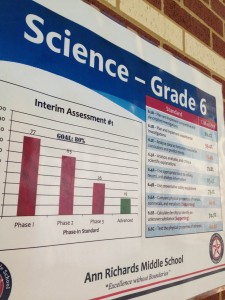
Performance management feels ambitious and consuming, yet logical. It requires faculty and staff members to examine metrics consistently, reflecting on their practices. The metrics and measures we examine are a representation of our school, and therefore they are a direct reflection of our instructional effectiveness. We must examine our reflection in the mirror.

nov003

At ARMS, there is a deep-seated belief in the importance of examining our true, and often harsh, reality through data. To improve student achievement and create college- and career-ready students, we must continually improve instruction, monitor progress, and evaluate our effectiveness. We must take a good, hard, long look in that mirror.

Our Goals: Changing Our Reflection

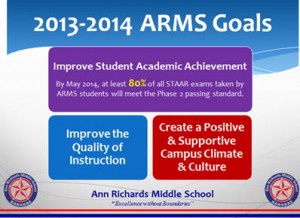
At ARMS, our goal is to create a culture of data-driven decisions for student improvement. We aim to establish a schoolwide data team and develop a data-use plan that uses common terminology. Our campus reviews lagging data and creates content goals in response. Engaging the entire staff in professional development, we will build capacity for investigating data and providing appropriate interventions and support for students. We also strive to connect our work on data to our simultaneous focus on the Habits of Mind.

nov004


Our Challenges: Disliking Our Reflection

Challenges often arise when educators don’t want to look in the mirror. The mirror’s reflection, or data, poses a challenging truth; as a result, excuses can become the norm. The three practices outlined in Performance Management Principle 1 (as described above by Ms. Knight) helped our campus to build a common goal and foundation for evidence-based decision-making. We have discovered that to deepen this commitment, we need to celebrate teachers when data-informed decisions have proven effective.

It is challenging to make students aware of their progress and to fully integrate them into the culture of data-driven instruction. The challenge lies in outlining the assessed curriculum in student-friendly and concise terms, so students are aware of what they are responsible for learning. Furthermore, providing time for students to evaluate their progress toward mastery of the curriculum has proven challenging. To support and encourage teacher and student discussions focused on data and feedback, we have implemented Student Advocacy Management (SAM) on our campus. SAM, a newly implemented district initiative, has been customized and tailored to meet our campus’ needs. Using a student-friendly reflection chart, staff members are provided a framework for data conversations with SAM students. The document encourages students to identify areas of growth based on their data, set goals, and work with a staff member to monitor their progress. If proven effective, our goal is to use this process to engage parents and community members.

nov006 nov005

Our Success: Enjoying Our Reflection

Although the SAM process specifically addresses our needs in one area, we have also used its data to successfully address the social and emotional needs of our students. During the first few months of school, pod leaders used attendance, behavior, and course performance data to identify our at-risk population. Strategically analyzing these data allows us to purposefully target individual students.

Schoolwide dedication to performance management also requires campus leadership to continuously exhibit the practices in Performance Management Principle 3. At ARMS, we have found great success in providing targeted professional development and support for teachers through our five instructional coaches and administrative team. Teachers now exhibit confidence during data conversations and collaboration.

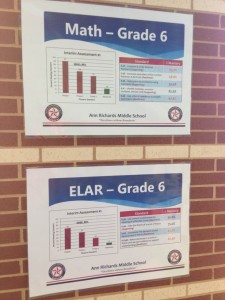
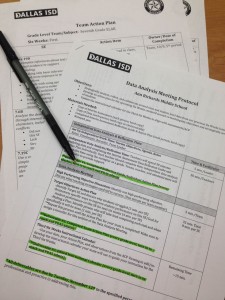
Finally, our protocols and reflection guides yield great benefits. Teachers begin by completing an individual analysis and reflection guide. Examining their own classroom’s reflection, the teacher identifies the four highest-priority standards, considers why these knowledge gaps exist, and considers various instructional practices for improvement. The content or grade-level teams reconvene to develop a specific, goal-focused action plan. The protocol (40-minute protocol or 90-minute protocol) is swift, providing each teacher specified amounts of time to share their struggles and brainstorm ways to improve instruction. Using that action plan, the teachers revise instructional calendars, collaborate to reteach lessons, and develop common quizzes or tests. The instructional coach facilitates the discussion, provides resources, and lends support where needed. This structured approach builds capacity in all participants while maintaining focus on the topic: changing our reflection.

nov007

Lessons Learned: Polishing the Mirror

  • When the reflection doesn’t change, we must. When data are stagnant, we must respond with urgency and perseverance. Though data analysis can feel personal, it is simply a factual representation of where we stand. If we don’t like where we stand, we must modify our instruction.
  • Show the community your reflection. Parents and guardians, as well as students, must receive guidance and support in understanding assessments and goals. The community is an integral part of our students’ lives and a key part of raising student achievement.
  • Be patient when the reflection is blurry. Provide protected time for teachers to collaborate and interpret data. Continuously build teachers’ capacity to analyze and understand data.
  • Celebrate! Even if celebrating the simple fact of making incremental steps in establishing performance management in our schools, we must create an optimistic culture around performance management.

nov008

Learn More

MSMI Clearinghouse

Many resources on implementing a performance management system are available in the Middle School Matters Institute Clearinghouse. These resources can be further filtered by intended audience or resource type.

ARMS Data Meeting Materials

Strategic Planning for Implementing Evidence-Based Practices in the Middle Grades

This month, the Middle School Matters Institute Blog focuses on strategic planning to effectively implement research-based strategies and practices in schools and classrooms.

Contributors:
Sarojani S. Mohammed, Middle School Matters Institute (Research Perspective)
David Barrett, Frank B. Agnew Middle School, Mesquite Independent School District (Practice Perspective)


The Research Perspective

When I first saw the Middle School Matters Research Platform and Field Guide, I was overwhelmed by the vast, comprehensive documents. Don’t get me wrong—I was heartened to see that so much research had been conducted to identify specific ways to improve the middle grades experience, but I knew it would be a challenge to support educators as they implemented the numerous research-based practices.

The research and practices described in the Field Guide serve as the foundation of Middle School Matters. It is critical for educators to understand what practices are most effective with middle grade students. But the real work of the Middle School Matters Institute (MSMI) is translating research into practice and assisting educators with implementing this practice.

Below, we describe how the Field Guide is organized, why we developed a specific planning process (the MSMI Implementation Plan Templates) aligned with the Field Guide, and how that planning process works. Finally, you will learn how one of the Middle School Matters “Tier II” schools has used the templates and the planning process to improve outcomes for its students.

Organization of the Middle School Matters Field Guide

The Middle School Matters Field Guide breaks down research into digestible parts. To begin, it is divided into three main sections, or pillars:

  1. Research-based instruction (for example, reading, writing, advanced reasoning)
  2. Student supports (for example, school climate, dropout prevention, extended learning time)
  3. Foundational dimensions (effective teaching, performance management, school leadership)

These three main parts are further divided into 13 “content dimensions,” or discrete areas in which the existing evidence base is summarized. Perhaps most importantly, the research within each content dimension is further distilled into a series of practical and applicable “principles” and “practices” that support each principle. This all sounds very hierarchical and complicated, but the bottom line is that the Middle School Matters Field Guide explicitly describes practices, validated by rigorous research, that are effective with middle grade students.

Also in the Field Guide are tools to improve individuals’ instructional practice, including the following:

  • Self-reflection questions that guide users’ critical thinking related to their practice
  • Quality frameworks that gauge the extent to which users implement these evidence-based practices

To help educators reflect on and plan instruction with the highest-needs students in mind, MSMI created Implementation Plan Templates—one for each of the 13 content dimensions in the Middle School Matters Research Platform and Field Guide. Our 2013 MSMI Summer Conference participants used these templates, and now, we’d like to share those templates with you. The three-step process in each template incorporates data-based instructional decision-making, helping schools use evidence to guide needs determination and action planning.

The Planning Process

Step 1: Self-Reflection
A critical first step to successful implementation of evidence-based practices is honest self-reflection on current practices that is based on evidence, not “hunches” or “gut feelings.” The MSMI Implementation Plan Templates ask schools to document what practices are in place, the extent to which they are in place, and the extent to which they are effective. School personnel gather and review evidence from reliable data sources and then indicate which instructional conditions are already in place. Schools document how they determined (in other words, what evidence they used) whether each condition was met. To encourage objective self-reflection, a “level of implementation” rubric is provided.

Step 2: Needs Determination
After reflecting, schools are guided through a needs determination process. Needs are classified into categories, which help schools problem-solve ways to address the needs. For example, a “translation” deficit exists when educators have basic knowledge about a principle but need support in translating this knowledge into instructional practice. Coaching, modeling, and scaffolding from an instructional leader who has successfully implemented the practice might address such a deficit.

Step 3: Action Planning
The final step in the planning process is developing action steps. Here, schools form specific implementation steps based on their previously identified needs and their goals for incorporating research-based practices. Schools also identify the individual(s) responsible for ensuring each action is completed and the date by which it should be completed. In this way, schools have a series of concrete steps to improve implementation of evidence-based practices. Schools also have documentation of where they began the process (their needs), and they can revisit their plans periodically to gauge any changes.

The goal of these templates is to develop manageable steps for the complex task of creating school transformation plans, so that research can be translated into practice in real classrooms for the benefit of real students. I hope that you find the templates to be useful, and if you don’t, we’d love to hear your suggestions for improvement.

Below, Agnew Middle School describes its experience with the MSMI Implementation Plan Templates, including real-world challenges and successes.

Reflections From the Field

Agnew Middle School’s RTI Campus Leadership Team has had an overall positive experience with the MSMI Implementation Plan Template. Like the Middle School Matters Field Guide, the planning template is very detailed—leaving no stone unturned. Such a document can be an excellent tool for driving growth, or it can be an overwhelmingly daunting task. It is the how that is the determinant. As a Middle School Matters Tier II participant, we can share our experience with this tool and offer some suggestions for how you can use it to facilitate continuous, data-driven improvement on your campus.

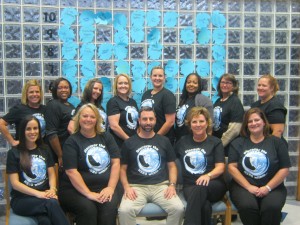
Agnew_Team_Photo

Our Experience

The Middle School Matters Field Guide is useful in both its depth and breadth. Likewise, the MSMI Implementation Plan Template is a thorough, logical, and sequential tool. As suggested by the MSMI team at the summer conference, it was especially helpful to limit our focus to three specific content dimensions this academic year. Based on needs already identified on our campus improvement plan, we chose Reading and Reading Interventions, School Climate/Culture, and Performance Management.

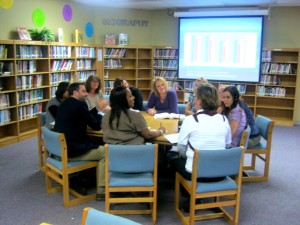
We focused on Reading and Reading Interventions for our initial use of the template. We were fortunate to have a facilitator from The Meadows Center for Preventing Educational Risk guide us through the process. Still, initial progress was slow, as our over-analytical minds wrestled with every detail and we debated finer points and the definition of terms. After powering through the first few principles, we called it a day and team members looked over the rest of the implementation plan individually. This first plan was completed the subsequent day.

We next moved to School Climate/Culture, a content dimension with fewer principles and practices than Reading and Reading Interventions. Having gained experience with the template, we moved more swiftly. Additionally, we had already made several improvements in this area on our campus. In hindsight, it might have been better for our team to start with this content dimension to achieve a “quick win,” gain momentum, and increase our confidence and understanding in this specific planning process.

Having completed two plans with the guidance of our facilitator, we felt confident creating the third plan on our own. Over the summer, our team met to complete planning in our third content dimension, Performance Management. Here, our understanding and mastery of the process were put to the test. Not only were we delving into this plan on our own, but also we had to train members of our campus leadership team who did not attend the conference. There is an old adage that the best way to learn something is to teach it. Indeed, as we explained and demonstrated the use of the template, it became apparent that our work at the MSMI conference, under the tutelage of our facilitator, had paid off, and our understanding of this tool expanded yet again.

The “action plan” is an integral piece of the planning template. Our team concretized our goals and objectives into actionable steps that got into the “nuts and bolts.” During this school year, we have referred to these steps frequently, especially during our bimonthly meetings. The action plan enables us to easily monitor our progress and to set and achieve short-term goals. Having this list of necessary steps, due dates, and people responsible has helped us sustain our progress.

Agnew_Team_Planning Agnew_Team_Plannin


Our Recommendations

As we mentioned, it is the process that can make or break a team’s success with this in-depth tool. Here, we present some of the lessons learned by Agnew Middle School.

  • Prepare for Planning: It is beneficial for the committee chair or principal to review the MSMI Implementation Plan Templates in depth before the full leadership team uses them. Then, he or she can present the templates to the team, discuss the planning steps and implementation stage rubric, and delegate the collection of necessary data and evidence to inform the self-reflection process.
  • Establish Immediate Success: To get the ball rolling, start with a content dimension that you already implement well and that you want to improve. That can help your team become familiar with the template, so that when you move on to another content dimension, you have established a good process.
  • Stay on Target: One of the benefits of the template is that it generates discussion and critical analysis. However, time is a precious commodity in education, and your team will not have enough time to discuss each topic that presents itself. Your team will need to stay focused and avoid “rabbit trails” (no matter how tantalizing they may be). Have individuals take notes on these side issues for discussion at a more appropriate time.
  • Speak the Same Language: One of our team’s initial challenges was finding a common language. Define terms from the outset. Here, the leader’s advance study of the template will help.
    Be Flexible: Treat these templates as a “living document,” especially the action steps. You will refer to these steps regularly throughout the year and, as always in education, you will have to modify and adjust.
  • Don’t Bite Off More Than You Can Chew: Change takes time. To establish and maintain momentum, develop a plan that lends itself to success, not one that overwhelms staff. Don’t develop too many action steps for a short of a period of time. It is better to do a couple of things really well than many things poorly.